Renovating or Expanding Your Home in Morbihan: Which Solution to Choose?
Three Questions to Make the Right Choice
There comes a time when a house is no longer enough. The children are growing up, remote work takes hold, a living space becomes too cramped, or you simply dream of opening up to the garden. The question then arises, almost always in the same terms: should you renovate the existing space, or expand?
In South Brittany, between stone farmhouses (longères), townhouses, and 1970s suburban homes, there is no single answer. But there is a method, and it starts with looking at the house exactly as it is.
When Renovation is the Obvious Choice
Renovating means first trusting what already exists. A house with character has a structure, a layout, and a history that no new construction can reproduce. Renovation makes perfect sense when:
- the volumes are already generous, but poorly distributed, dark, or partitioned: redistributing, opening up, and letting in light is often enough to gain an "invisible" room;
- the house has character to preserve : exposed stone, roof framework, old proportions;
- the main flaw is thermal : a poorly insulated house isn't necessarily too small, it's too cold. This is precisely the challenge of energy renovation in Brittany, which improves comfort and property value without altering its footprint.
When an Extension Becomes Evident
An extension responds to a need that renovation alone cannot fulfill: additional surface area. It is relevant when:
- the family or your needs have changed : an extra bedroom, an office, a master suite, a true living room;
- the plot allows for it, with a garden to enhance rather than sacrifice;
- the existing building can no longer be optimized without losing its charm.
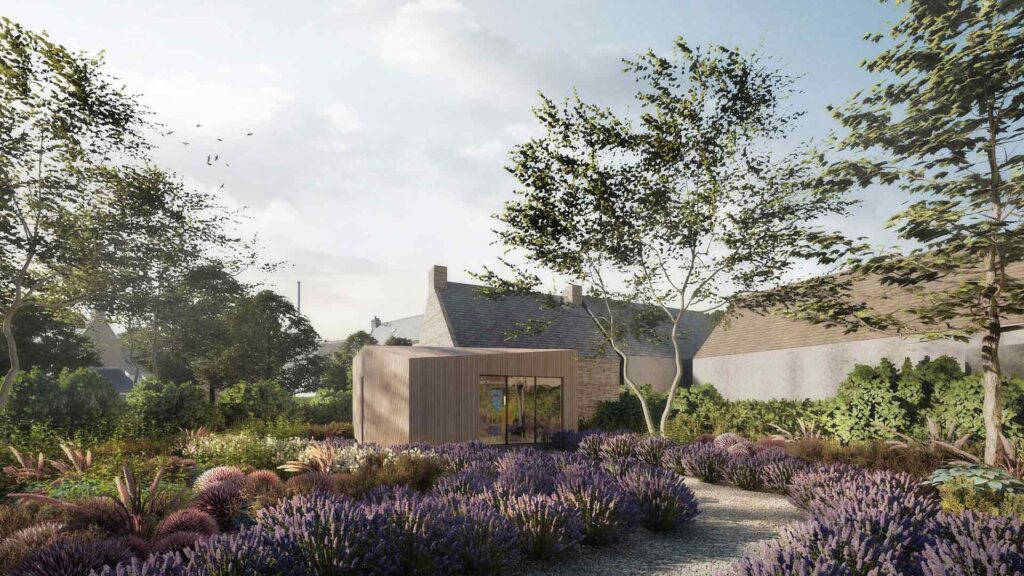
It is also an opportunity to write a new chapter. At the Glazen House, a wooden extension—made of a warm and naturally insulating material—prolongs the stone house and opens it to its garden. The contrast between the old and the contemporary then becomes a strength, not a compromise.
Often, the Right Answer is: Both
In practice, the question isn't always "one or the other". The most successful projects often combine a deep renovation and an extension designed as a natural continuation of the house.
This is the case of the Kervarh House, a 19th-century longère where the renovation of the stone and the wooden extension dialogue in a single gesture. The house gains in surface area, light, and comfort, without losing its soul.
What the Plot and the Budget Say
No calculation rule replaces an on-site assessment, but a few benchmarks can help guide you:
- A heavy renovation is not always the least expensive solution : structural repairs, insulation, utility networks, and joinery quickly weigh on the budget. Conversely, a well-designed extension can leave the existing building almost intact.
- The plot matters as much as the house : layout, orientation, distance to property lines, access, presence of protected areas. On the Breton coastline, these constraints are frequent.
- The best budget is the one you understand : an initial diagnosis allows for comparing concrete scenarios rather than relying on intuition.
Urban Planning Rules to Anticipate
The choice between renovating and expanding also has an administrative dimension that is often underestimated. As general guidelines:
- the renovation works that modify the external appearance (facades, openings, roof) generally require a prior declaration of work (déclaration préalable) ;
- an extension requires a prior declaration or a building permit (permis de construire) depending on its surface area and the municipality's local urban plan (PLU);
- beyond a total surface area of 150 m² after works, using an architect becomes mandatory to file a building permit.
These thresholds depend on your plot (PLU zone, protected sector, Coastal Law) and evolve with regulations. Before making any decision, it is therefore essential to have them checked for your project. We discuss this in more detail in our article on regularization and administrative expertise, and you will find answers to frequently asked questions in our FAQ..
Three Questions to Ask Yourself Before Deciding
- What do I really need? More space, or to better use the space I have?
- What do I absolutely want to keep? The stone, the roof framework, a view, a tree, an atmosphere.
- What is the priority: comfort, space, energy performance, property value? Each guides the answer differently.
Our Support: Deciding with an Architect's Eye
At Atelier Glaz, we never start with a ready-made solution. We begin by visiting the house, understanding the plot, and listening to how you live. We then compare several scenarios (renovation only, extension only, or both) before recommending the most appropriate one, from the perspective of budget, light, and the spirit of the place.
Your House Can Still Grow
Whether you are hesitating between redistributing your rooms, opening your longère to the garden, or imagining a wooden extension, the first step is the same: looking at the house with fresh eyes.
Are you considering renovating or expanding your home in Morbihan? Let's talk about it together.